Blogs
What's New Trending

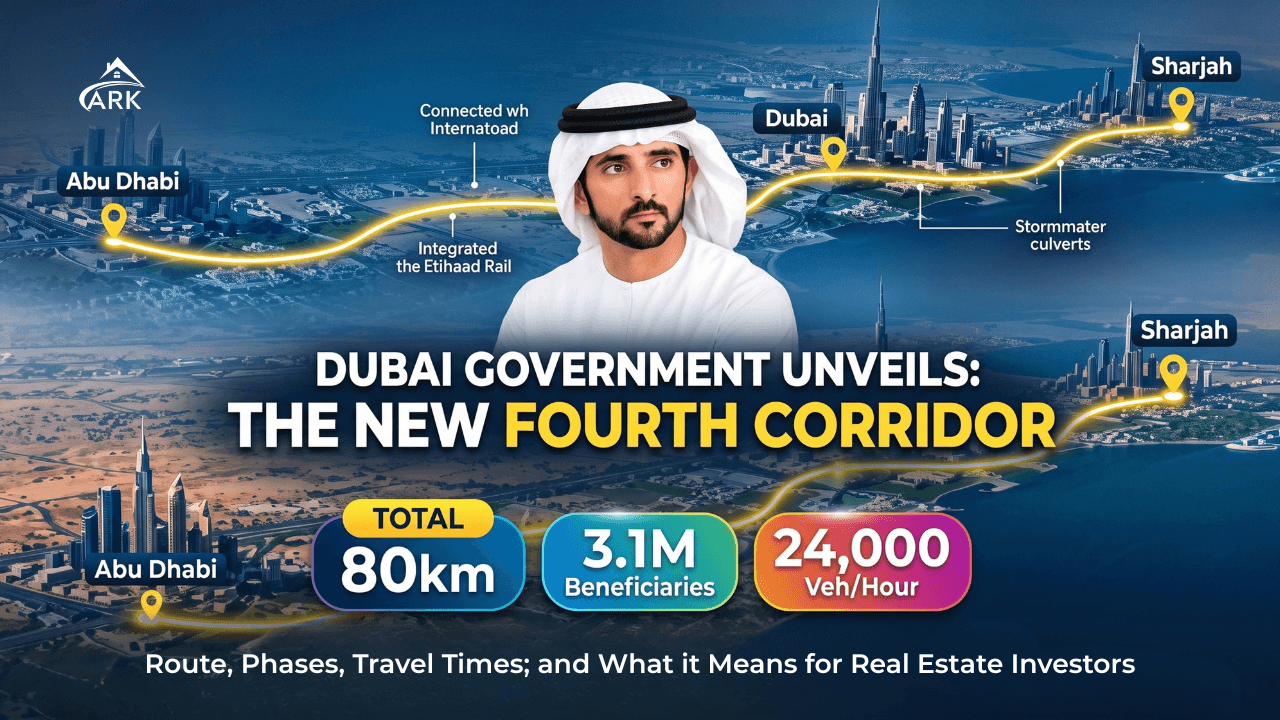


The Government of Dubai has announced the implementation of the New Fourth Corridor, an expansive 80-kilometre transit route spanning from Al Shanouf Road in Sharjah through Dubai to Al Faya Road in Abu Dhabi. Approved by His Highness Sheikh Hamdan bin Mohammed bin Rashid Al Maktoum, Crown Prince of Dubai, Deputy Prime Minister and Minister of Defence of the UAE, and Chairman of The Executive Council of Dubai, the expressway is slated to become one of the country’s most significant arterial infrastructure assets.
Representing the fourth major highway linking the UAE’s emirates—alongside Sheikh Zayed Road (E11), Sheikh Mohammed bin Zayed Road (E311), and Emirates Road (E611)—this corridor is engineered to reduce inter-emirate travel times by more than 50% while diverting cross-country freight traffic out of high-density urban areas.
As rapid urban and population growth continues across the UAE, inter-emirate transit routes absorb a combination of private passenger vehicles, public transit, and commercial freight. The New Fourth Corridor establishes a dedicated, high-capacity bypass around the urban periphery, delivering three strategic advantages:
Heavy Traffic Diversion: Moving long-distance logistics and heavy transport away from central business districts to improve overall road safety and ease bottlenecks on existing corridors.
Economic Node Interconnection: Creating direct physical linkages between high-value infrastructure, including Al Maktoum International Airport (DWC), the Etihad Rail network, and key master-planned communities.
Environmental and Heritage Safeguards: Thoughtfully routed through scenic and protected terrain, including the Al Marmoom Desert Conservation Reserve and Al Wohoosh Desert Conservation Reserve, integrating sustainable engineering standards like modern stormwater drainage systems.
The megaproject is divided into two primary execution phases to accelerate civil construction and guarantee on-schedule completion.
| Feature / Metric | Phase 1 | Phase 2 | Total Project |
| Route Stretch | Al Shanouf Rd (Sharjah) to Dubai–Al Ain Rd | Dubai–Al Ain Rd to Al Faya Rd (Abu Dhabi) | Sharjah to Abu Dhabi border |
| Length | ~30 km | ~50 km | ~80 km |
| Estimated Cost | ~AED 3.5 Billion | To be announced | Multi-billion AED |
| Lane Configuration | 12 through lanes (both directions) | 12 through lanes (both directions) | 12 through lanes throughout |
| Capacity | 24,000 vehicles/hour | 24,000 vehicles/hour | 24,000 vehicles/hour |
| Population Served | 600,000 people | 3,100,000 people | 3.7+ Million beneficiaries |
| Travel Time Saving | Cut from 35 min to 14 min (-60%) | Cut from 50 min to 24 min (-52%) | More than half across key sections |

Covering the northern 30-kilometre stretch, Phase 1 represents an initial investment of AED 3.5 billion. Construction scope includes:
Phase 2 tackles the longer 50-kilometre southern expanse, directly connecting central Dubai routes to Abu Dhabi’s arterial network at Al Faya Road. Construction scope includes:
To maintain uninterrupted speed profiles and accommodate heavy axle-load vehicles without disrupting local topography or delicate desert habitats, the overall New Fourth Corridor encompasses:

Beyond easing the daily commute for residents, the New Fourth Corridor provides critical operational value for the logistics sector. By providing heavy goods vehicles (HGVs) a rapid, high-capacity pathway directly linking industrial zones in Abu Dhabi and Sharjah with Al Maktoum International Airport and Etihad Rail freight depots, the corridor lowers haulage cycle times and fuel consumption.
Concurrently, areas adjacent to outer Dubai—such as Dubai South, Dubailand, and communities flanking Lehbab Road—stand to benefit from enhanced accessibility, accelerating future master-planned residential and industrial developments.
The New Fourth Corridor is an 80-kilometre, 12-lane highway project connecting Al Shanouf Road in Sharjah to Al Faya Road in Abu Dhabi via Dubai, designed to divert through-traffic and dramatically cut inter-emirate journey times.
The Fourth Corridor complements three established arterial highways connecting the emirates: Sheikh Zayed Road / Al Ittihad Road (E11), Sheikh Mohammed bin Zayed Road (E311), and Emirates Road (E611).
Phase 1 will reduce a typical 35-minute commute down to 14 minutes (a 60% reduction), while Phase 2 will cut a 50-minute route down to 24 minutes (a 52% reduction).
Yes. The corridor integrates directly with the Etihad Rail route and provides direct logistical access to Al Maktoum International Airport (DWC).
For more insights into the UAE real estate market, stay tuned to ARK Real Estate.
Looking to Buy or Rent a property in Dubai? Reach out to us on info@arkrealstatedubai.com
Get latest news and update

Leave a Reply